
4+2 Assessment Requirements: Are you well prepared for June 30, 2027?
Aug 28, 2026
If you are completing the 4+2 internship, assessment is an area you need to keep track of throughout your internship. Under the 4+2 requirements, you must develop the knowledge and skills required for Domain 2: Assessment of the National Psychology Examination curriculum. By the end of your internship, you need to demonstrate proficiency in the administration, scoring and interpretation of at least nine different psychological tests and instruments.
With the 4+2 pathway ending on 30 June 2027, now is a good time to check where you are up to — and whether you have access to the resources you need to finish your assessment requirements.
What are the nine tests?
Your nine tests and instruments must include:
- 1 adult test of intelligence eg. Wechsler Adult Intelligence Scale (WAIS)
- 1 child test of intelligence eg. Wechsler Intelligence Scale for Children (WISC)
- 1 specialised test of memory eg. Wide Range Assessment of Memory and Learning (WRAML)
- 2 standardised personality tests eg. NEO Personality Inventory and Personality Assessment Inventory (PAI)
- 4 other tests selected from the National Psychology Examination curriculum (full list is below).
-
You need to administer, score and interpret each test as many times as necessary to achieve competence. You must then competently demonstrate each test at least twice to your supervisor through direct observation with real clients or, where appropriate, in a realistic simulated learning environment.
So, having used a test once does not mean you have completed the requirement. You need to develop competence and complete the required observations.
Do you have access to the resources you need?
One of the first things to consider is whether you can actually access the tests and instruments you need through your workplace.
Some interns have regular access to a broad range of psychological assessment tools, while others may work in settings where assessment resources are limited. If you cannot access the tests you need at work, talk to your supervisor early about other options you may have to access these resources, also consider whether you have access to everything required to use the test properly, including manuals, administration materials, scoring resources and interpretation information.
What can you access through Provisional Psychologist Hub?
Memberships
Our supervisors maintain an extensive psychometric assessment library, which serves as a valuable resource for the training and supervision of aspiring psychologists in this field.
Bronze, Silver, Gold and Platinum Members can access the Provisional Psychologist Hub Psychometric Assessment Library after four months of membership. The library provides members with access to a selection of physical psychometric assessment resources that can support their learning, assessment training and development of competence as they work towards general registration. Resources currently available include;
- Wechsler Adult Intelligence Scale - Fourth Edition Australian and New Zealand (WAIS-IV)
- Wechsler Intelligence Scale for Children, Fifth Edition: Australian and New Zealand Standardised Edition (WISC-V A&NZ)
- Wide Range Assessment of Memory and Learning, Third Edition (WRAML-3)
- Personality Assessment Inventory (PAI)
- NEO Personality Inventory-3 (NEO PI-3)
Access to psychometric assessment resources is provided solely for the purpose of demonstrating competence to achieve general registration.
Membership Information: https://www.provisionalpsych.com.au/join
Psychometric Assessment Resource Information: https://www.provisionalpsych.com.au/psychometricassessment
How can the Digital Assessment Library help?
If you are working through your 4+2 assessment requirements, you may also be wondering how the Digital Assessment Library for Provisional Psychologists (DAL-P) can support you.
The DAL-P was developed specifically to help provisional psychologists access assessment resources that can otherwise be difficult to access during an internship. It provides digital manuals and stimulus materials for a selection of assessments aligned with the National Psychology Examination curriculum and internship requirements.
The DAL-P can be particularly useful when you are learning a test for the first time. You can use the available manuals to develop your understanding of:
- what the assessment measures
- when it is appropriate to use
- how it is administered
- scoring procedures
- interpretation
- psychometric properties
- limitations and considerations when using the assessment.
This can help you prepare before administering an assessment with a client and give you a resource to return to as you develop your competence.
Remember, however, that the DAL-P provides manuals and stimulus materials only. It is not a complete test kit and is not, by itself, sufficient to administer, score or interpret every assessment. Complete test materials and appropriate supervision are still required.
The DAL-P can also be useful when preparing for the National Psychology Examination. The assessment domain of the NPE requires detailed knowledge of six core tests and general familiarity with an additional 22 tests. The Board recommends that candidates refer to test publisher manuals when preparing for the examination.
Having access to the relevant manuals means you can go beyond simply memorising the names of assessments. You can use the publisher's material to develop a deeper understanding of the tests, including their purpose, administration, scoring, interpretation and limitations.
This can be particularly useful when you are preparing for assessment questions in the NPE or revising a test you have not used recently.
Keep track of your progress
Don't rely on memory to keep track of nine different tests, multiple administrations and two observations for each test. A simple tracker can make it much easier to see what you have completed and what still needs attention.
| Test / Instrument | Category | Resource Access | Practised | Competent | Observation 1 | Observation 2 |
|---|---|---|---|---|---|---|
| Adult intelligence | ☐ | ☐ | ☐ | ☐ | ☐ | |
| Child intelligence | ☐ | ☐ | ☐ | ☐ | ☐ | |
| Memory | ☐ | ☐ | ☐ | ☐ | ☐ | |
| Personality 1 | ☐ | ☐ | ☐ | ☐ | ☐ | |
| Personality 2 | ☐ | ☐ | ☐ | ☐ | ☐ | |
| Other 1 | ☐ | ☐ | ☐ | ☐ | ☐ | |
| Other 2 | ☐ | ☐ | ☐ | ☐ | ☐ | |
| Other 3 | ☐ | ☐ | ☐ | ☐ | ☐ | |
| Other 4 | ☐ | ☐ | ☐ | ☐ | ☐ |
Use the tracker with your supervisor to identify any gaps. If you are missing access to a particular resource, need more opportunities to practise or still need direct observations, you can address those issues before they become a last-minute problem.
Don't forget your practice documents portfolio
Assessment requirements also include a practice documents portfolio.
You need to assemble eight different practice documents that you have written and that your supervisor considers to be at a standard acceptable for an entry-level general psychologist.
These may include:
- referral letters
- assessment or intervention reports
- case notes
- individual or group session plans
- intervention plans
- case formulations
- other relevant documents agreed with your supervisor.
Your documents should also demonstrate that you understand and comply with the relevant legal, ethical, professional and organisational requirements, including record-keeping and privacy. Rather than trying to find eight documents at the end of your internship, build your portfolio as you go.
Starting from Scratch?
If you haven't yet completed any of your nine tests, don't panic — but do start planning now. You have a finite amount of time to develop competence, complete practice administrations and arrange the required direct observations.
A sensible first step is to work backwards from 30 June 2027 and create a plan with your supervisor. The following table is a planning guide only. Your individual timeframe will depend on your practice setting, access to resources, client presentations and supervisor availability.
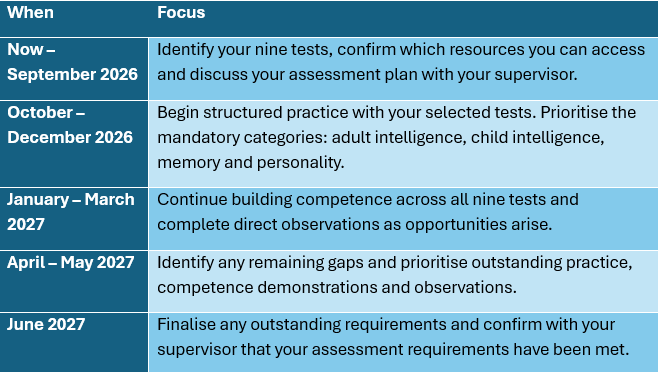
The important thing is not to leave all nine tests until 2027. Some tests may require multiple administrations before you demonstrate competence, and you need two competent direct observations for each test. If you are relying on particular types of clients or assessment opportunities, those opportunities may not arise exactly when you need them.
If you are starting from scratch, speak with your supervisor now. Together, you can identify the tests that are realistic for your practice setting, work out what resources you need and start scheduling opportunities to build and demonstrate your competence.
Take stock now
If you are a 4+2 intern, take some time to review your assessment requirements with your supervisor.
Ask yourself:
- Do I have access to the resources I need?
- Which of my nine tests have I developed competence in?
- Which tests still need more practice?
- Have I completed both required observations for each test?
- Do I have eight suitable practice documents in my portfolio?
If you identify gaps, don't panic. The important thing is to identify them, discuss them with your supervisor and make a plan.
With the right resources, supervision and a clear plan, you can keep building your assessment competence and work towards completing your 4+2 requirements by 30 June 2027.
Resources and Supervision Support
Psychometric Assessment Resources
Access to the right resources is key to developing your psychometric assessment competence. Explore the range of resources available to Provisional Psychologist Hub supervisees, along with the additional resources and benefits available exclusively to our Bronze, Silver, Gold and Platinum Members. And with the support of our fantastic partners, Pearson Clinical Assessment and NovoPsych, access to psychometric assessment tools and resources has never been more accessible or affordable.
More information is available here; https://www.provisionalpsych.com.au/psychometricassessment
Contact us here; https://www.provisionalpsych.com.au/contact
Assessment Supervision
Provisional Psychologist Hub provides targeted supervision to support the development of your assessment knowledge, skills and competence throughout your internship.
Assessment supervision provides an opportunity to discuss assessment processes, case formulation, selection and use of assessment tools, interpretation of results, and clinical decision-making. Our supervisors can help you build confidence in applying assessment principles to your practice and identify opportunities for further learning and professional development.
Whether you are developing your foundational assessment skills or seeking to strengthen your competence with specific assessment tools and approaches, supervision provides a supportive space to ask questions, explore clinical reasoning and reflect on your practice.
You can search for a supervisor in accordance of a specific test or just choose a supervisor who is experienced in psychometric assessment to support you.
- Find a Supervisor (Psychometric Assessment) https://findasupervisor.provisionalpsych.com.au/search-results?tid=305&ttid=491
- OR Find a Supervisor (Select a Test>Supervision for Psychometric Assessments) https://findasupervisor.provisionalpsych.com.au/
- Book Supervision https://clientportal.zandahealth.com/clientportal/pph/home
Want to stay up to date?
Subscribe to our newsletter for monthly updates and helpful information.
Unsubscribe at anytime!
